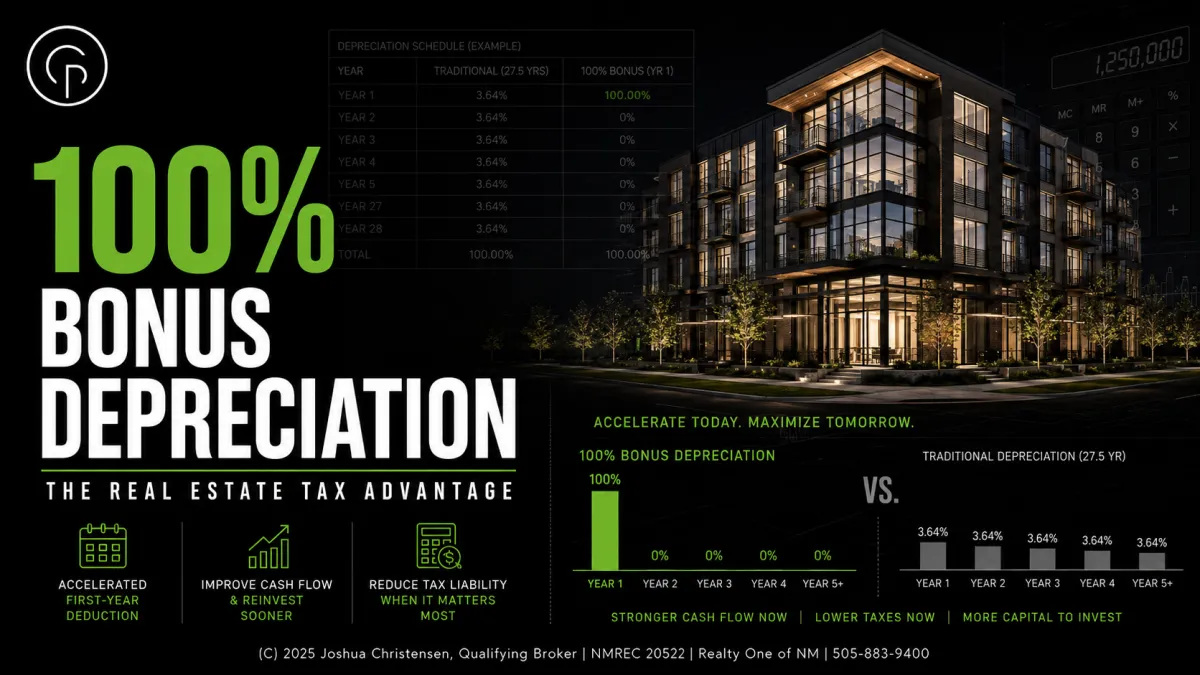
100% Bonus Depreciation in 2026: What Real Estate Investors Need to Know
Real estate investors have once again been handed a powerful tax-planning tool:
100% bonus depreciation.
But before anybody starts calculating a massive first-year write-off on the entire purchase price of a commercial building or rental property, we need to clear something up.
100% bonus depreciation does not mean you can automatically deduct 100% of a real estate purchase.
The rules apply to qualifying depreciable property.
That distinction changes everything.
Understanding what qualifies, what doesn't, how property gets classified and whether you can actually use the resulting deduction is where the real strategy begins.
First: What Changed?
Public Law 119-21 was signed into law on July 4, 2025. Section 70301 amended Internal Revenue Code Section 168(k) and replaced the previous bonus-depreciation phase-down with a permanent 100% additional first-year depreciation deduction for qualified property acquired after January 19, 2025, subject to the rules governing qualification and placed-in-service requirements.
Treasury and the IRS followed with Notice 2026-11, providing interim guidance on the updated rules. The IRS described the law as providing a permanent 100% additional first-year depreciation deduction for eligible depreciable property acquired after January 19, 2025.
"Permanent" is important, but it should be understood correctly.
Under current law, there is no scheduled percentage phase-down like the one investors previously faced.
That does not mean Congress could never change the law again.
It means the current statute no longer contains the previous automatic phase-down schedule for qualifying post-January 19, 2025 property.
What Is Bonus Depreciation?
Normal depreciation spreads the tax recovery of an asset's depreciable basis across a prescribed recovery period.
Bonus depreciation changes the timing.
For qualifying property, current Section 168(k) rules may allow the taxpayer to deduct 100% of the qualifying property's eligible basis during the first year rather than recovering that basis gradually over several years.
This is why bonus depreciation can be so significant.
It is not necessarily giving the investor a deduction that would never otherwise exist.
It is potentially moving deductions forward in time.
And timing can matter enormously when investors are trying to keep capital productive.
The Entire Building Does Not Automatically Qualify
This is where a lot of social-media explanations go off the rails.
Imagine purchasing a $2.5 million commercial building.
You cannot simply say:
"$2.5 million property × 100% bonus depreciation = $2.5 million immediate deduction."
That is not how the real-estate rules work.
Land is generally not depreciable.
The structural building itself generally remains subject to its applicable real-property depreciation life.
The important question becomes:
What qualifying shorter-life assets exist inside and around the property?
And that leads directly to another real estate tax strategy.
A cost segregation study can analyze the property and determine whether portions of the acquisition basis properly belong in shorter depreciation classes rather than remaining entirely within the building's 27.5- or 39-year classification.
Why Cost Segregation and Bonus Depreciation Work Together
Think of the process in this order:
Step 1: Acquire the property
Assume an investor purchases an income-producing commercial property.
Step 2: Determine the property's tax basis
The investor and tax professionals properly allocate basis between land and depreciable property.
Step 3: Identify the individual components
A cost segregation analysis examines assets inside and around the building.
Step 4: Assign appropriate depreciation classifications
Certain property might qualify for shorter recovery periods.
Step 5: Determine bonus-depreciation eligibility
If shorter-life assets satisfy Section 168(k)'s requirements, current law may permit 100% additional first-year depreciation.
Cost segregation therefore helps answer:
"What did I actually buy?"
Bonus depreciation helps answer:
"How quickly can qualifying assets be depreciated?"
They are separate strategies, but they can work extremely well together.
A Simplified $2.5 Million Example
Let's use the same hypothetical commercial property:
Purchase Price: $2,500,000
Land Allocation: $500,000
Depreciable Basis: $2,000,000
Suppose a professionally prepared cost segregation study determines that:
$500,000 is properly classified into qualifying shorter-life assets
and:
$1,500,000 remains classified as 39-year nonresidential real property.
Now we have two separate tax buckets.
The $1.5 million building portion generally remains subject to its applicable real-property depreciation rules.
But if the $500,000 of shorter-life property meets the requirements of Section 168(k), some or potentially all of that qualifying basis may be eligible for 100% additional first-year depreciation under current law.
That is where the strategy becomes powerful.
Instead of waiting years to recover that $500,000 of qualifying basis, the investor may potentially accelerate the deduction into the first year.
But remember:
A $500,000 tax deduction is not a $500,000 tax credit.
The tax effect depends upon the investor's taxable income, tax rate and ability to use the deduction.

Can Used Property Qualify?
This is particularly relevant to real estate investors because most investors are not purchasing newly constructed buildings every time they make an acquisition.
The IRS specifically addresses the ability of certain used property to qualify for bonus depreciation, provided the statutory requirements are satisfied.
That means investors acquiring existing income-producing real estate may still have a bonus-depreciation opportunity associated with qualifying components.
Again, the distinction is important:
The used building itself does not automatically become 100% bonus-depreciable.
Rather, qualifying depreciable assets acquired as part of the transaction may be eligible when the applicable requirements are satisfied.
The Most Important Question: Can You Actually Use the Deduction?
Generating depreciation and using depreciation are not always the same thing.
Rental real estate is generally treated as a passive activity for federal tax purposes, although important exceptions apply.
IRS Publication 925 states that a rental activity generally remains passive even when the taxpayer materially participates unless the applicable real-estate-professional requirements are satisfied.
That means an investor could potentially create a very large depreciation loss while still having limitations on how much of that loss can currently offset wages or other nonpassive income.
There is also a special allowance for certain taxpayers who actively participate in qualifying rental real estate, subject to statutory limits and phaseouts. IRS Form 8582 guidance discusses the potential special allowance of up to $25,000 in qualifying circumstances.
This is why bonus depreciation should not be viewed in isolation.
Before chasing the largest possible first-year deduction, ask your CPA:
"If we create this deduction, can I actually use it?"
That one question can change the strategy dramatically.
Real Estate Professional Status Can Change the Analysis
Federal tax law contains a specific standard for real estate professional treatment.
Owning several rentals does not automatically qualify someone.
Being licensed as a real estate broker does not, by itself, automatically answer the tax question either.
The applicable tests involve the taxpayer's activities and participation.
Publication 925 should be reviewed with your CPA when determining how rental losses may apply to your individual situation.
For some investors, that issue may determine whether accelerated depreciation produces an immediate tax benefit or creates suspended losses that may be used later under applicable rules.
Bigger Is Not Always Better
This is another place where Operators need to think differently.
Suppose you qualify for a substantial bonus-depreciation deduction.
Should you always take the largest possible deduction immediately?
Not necessarily.
Current rules include elections relating to additional first-year depreciation. Notice 2026-11 specifically addresses elections available under Section 168(k), including certain circumstances in which taxpayers may elect different treatment.
Depending upon the investor, there may be strategic reasons to consider:
Current taxable income
Expected future taxable income
Passive-loss limitations
Future tax rates
State income-tax treatment
Partnership structures
Planned disposition dates
Depreciation recapture
Available suspended losses
Other deductions or tax attributes
The objective should not automatically be:
Maximum deduction this year.
The better objective may be:
Best after-tax result across multiple years.
Bonus Depreciation Is an Acceleration Strategy
Think about two hypothetical deductions:
Deduction A: $100,000 today
versus
Deduction B: $100,000 spread across many future years.
Ignoring other tax variables, those are not economically identical.
A legitimate deduction received earlier may allow the investor to retain capital sooner.
That capital could potentially be redirected into:
Property reserves
Renovations
Debt reduction
Another down payment
New equipment
Additional income-producing assets
This is where depreciation moves beyond tax preparation.
It becomes part of a capital-allocation strategy.
But Preserving Capital Is Only Valuable if You Use It Productively
This is where I think investors need to challenge themselves.
If a tax strategy allows you to retain $100,000 and you immediately spend the money on another liability, what exactly did the strategy accomplish?
Contrast that with an Operator who uses retained capital to:
Acquire → Improve → Operate → Generate Cash Flow → Reinvest
Now the tax benefit becomes fuel for the investment system.
That is a very different use of the same deduction.
The real opportunity is not simply paying less tax today.
The opportunity is potentially keeping more productive capital inside a system that generates future income.
Do Not Ignore Basis Reduction
There is another side to accelerated depreciation.
Depreciation generally reduces adjusted basis.
IRS Publication 551 explains that depreciation deductions reduce the basis of property.
That means accelerating depreciation today can affect the tax calculations surrounding a future sale.
This is not a reason to reject bonus depreciation.
It is a reason to understand what you are doing.
What About Depreciation Recapture?
When depreciated property is sold at a gain, federal depreciation-recapture rules may apply depending upon the property classification and transaction.
IRS Publication 544 covers sales and dispositions of property and the rules surrounding depreciation recapture.
This becomes particularly relevant when cost segregation moves portions of a building into personal-property classifications.
An investor therefore needs to think beyond acquisition year.
The better analysis is:
Purchase → Depreciation → Cash Flow → Holding Period → Exit
not simply:
Purchase → Huge Tax Deduction
What About a 1031 Exchange?
A like-kind exchange can be an important real estate tax-deferral strategy, but investors should not assume that saying "I'll just 1031 it" automatically eliminates every issue associated with accelerated depreciation.
Different asset classifications and depreciation histories can create more complicated disposition questions.
Your CPA should understand the original cost segregation study and accumulated depreciation before the property is sold or exchanged.
Tax planning works best before the transaction.
Not after closing.
Don't Buy a Bad Deal for a Tax Deduction
This deserves its own section because investors get in trouble here.
Imagine someone telling you:
"Buy this property because you'll get a $400,000 deduction."
Wrong reason.
The property still needs to survive basic investment math.
You still need to understand:
Purchase price
Actual rent
Net operating income
Debt service
Vacancy
Repairs
Capital expenditures
Insurance
Taxes
Cash flow
Market conditions
Exit risk
A tax deduction cannot make an economically broken property healthy.
The investment should work before the tax strategy.
Then tax efficiency can potentially make a good investment even better.
Why the Cost Segregation Analysis Comes First
Bonus depreciation cannot be analyzed properly without knowing which assets actually qualify.
That's why real estate investors should understand the companion strategy.
Read Next: Cost Segregation in Real Estate: How Investors Accelerate Depreciation and Preserve Capital
That article explains how a building can be separated into different asset classifications and why the quality of the cost segregation study matters.
Questions to Ask Your CPA Before Taking Bonus Depreciation
Before implementing the strategy, discuss these questions with your CPA or licensed tax advisor:
Which of my assets actually qualify for bonus depreciation?
When were those assets acquired?
When were they placed in service?
Would a cost segregation study identify additional qualifying property?
Can I currently use the resulting losses?
Are my activities passive or nonpassive?
Could real estate professional rules affect me?
Do at-risk limitations apply?
Should I take 100% bonus depreciation or consider an available election?
How does my state treat bonus depreciation?
What happens to my adjusted basis?
What happens when I sell the property?
What potential depreciation recapture should I model?
How does this fit into my overall investment strategy?
That is the conversation worth having.
Final Thought
100% bonus depreciation is powerful.
But its power does not come from a government loophole or some magical ability to make an entire real estate purchase disappear from your tax return.
The power comes from understanding:
What you purchased.
How the assets are classified.
Which assets qualify.
When deductions become available.
Whether you can use them.
And what you do with the capital you preserve.
Current federal law has once again made accelerated depreciation highly relevant to real estate investors. The IRS states that for most qualifying business property bought and placed in service after January 19, 2025, businesses can deduct 100% of qualifying cost in the first year under the updated rules.
Used correctly, that can be an important piece of a larger real estate investment system.
Used carelessly, it can become nothing more than another tax-sales pitch.
Think like an Operator.
Buy the right property first.
Then structure the tax strategy around the investment.
READ:
Cost Segregation in Real Estate: How Investors Accelerate Depreciation and Preserve Capital
Tax Disclaimer
Joshua Christensen is a real estate broker and investor and is not a Certified Public Accountant (CPA), licensed tax advisor, or attorney. This article is provided solely for general educational and informational purposes and should not be construed as tax, accounting, financial, investment, or legal advice or counsel. Every taxpayer and investment situation is different. Tax laws and their application can vary based upon income, ownership structure, participation, property type, state law and other circumstances. Always consult your own CPA, licensed tax professional and legal counsel before implementing a tax strategy or making an investment decision based upon potential tax consequences.
Official Resources
Treasury / IRS guidance regarding the 100% additional first-year depreciation deduction and Notice 2026-11.
Public Law 119-21, enacted July 4, 2025.
IRS Bonus Depreciation FAQs.
IRS Publication 946 — How to Depreciate Property.
IRS Publication 925 — Passive Activity and At-Risk Rules.



