Mortgage Rate History: Are Today's 7% Rates Really High?
If you're looking at a mortgage rate around 7% today and thinking, “There is no way I am buying a house at that rate,” you are certainly not alone.
For millions of Americans, anything above 5% feels expensive.
But here's the problem.
Our perception of a “normal” mortgage rate has been heavily influenced by one of the most unusual periods in American financial history.
Mortgage rates below 4% were not normal.
Rates near 3% were definitely not normal.
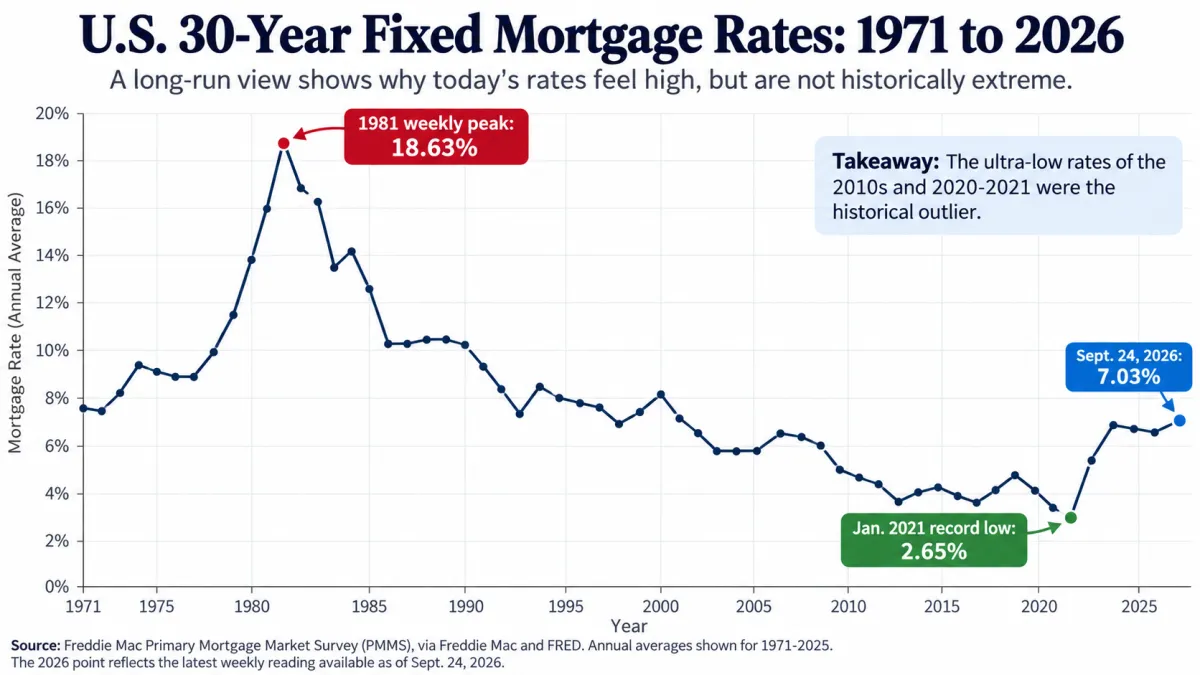
And the 2.65% average 30-year mortgage rate reached in January 2021 was an all-time low, according to Freddie Mac.
So here's the question that matters:
Are today's mortgage rates actually historically high?
Not really, if we compare them with the broader modern history of mortgage lending.
But that doesn't mean today's housing market is inexpensive.
Those are two completely different questions.
Today's buyers are dealing with the combination of higher mortgage rates, dramatically higher home prices, insurance costs, taxes and general inflation. So affordability can still be difficult even if a 7% mortgage rate itself isn't historically extreme.
Understanding that difference requires going back much farther than 2020.
Let's go all the way back to the 1920s.
What Were Mortgages Like in the 1920s?
Comparing today's mortgage rate directly with a mortgage from 1925 is difficult because the mortgage itself was a very different financial product.
There is no clean nationwide Freddie Mac-style mortgage rate index running back to the 1920s.
And more importantly, the typical mortgage wasn't today's familiar:
30-year fixed-rate loan with equal monthly payments.
Before the Great Depression, many mortgages lasted only three to five years and commonly covered no more than about 60% of the property's value.
The remaining principal often came due as a large balloon payment.
Borrowers frequently expected to refinance that balloon into another mortgage.
HUD's historical research describes these pre-Depression mortgages as short-term balloon loans, often forcing borrowers to refinance when the loan matured.
Think about that for a moment.
Today we worry about whether our interest rate is 6.5% or 7%.
A homeowner in the 1920s might have been worrying about something much more fundamental:
Will a bank refinance my entire mortgage when it comes due three years from now?
That system worked while credit remained available.
Then 1929 happened.
The Great Depression Changed the American Mortgage
The stock market crashed in 1929.
Banks began failing.
Credit disappeared.
Unemployment exploded.
And homeowners who had expected to refinance their balloon mortgages suddenly couldn't.
By 1933, the banking system had suffered enormous failures and mortgage defaults were widespread. HUD historical research reports that more than half of mortgages were in default by that point.
The federal government responded by fundamentally restructuring American housing finance.
The Home Owners' Loan Corporation helped refinance distressed homeowners into longer-term loans.
Then the Federal Housing Administration was created in 1934.
FHA mortgage insurance helped popularize something revolutionary:
the long-term, fixed-rate, fully amortizing mortgage.
Instead of repeatedly refinancing a balloon mortgage, the borrower could make predictable payments that gradually paid the loan off. HUD User
That structure eventually evolved into the mortgage most Americans recognize today.
The important point is this:
Mortgage history isn't simply a story about interest rates.
It's also a story about how Americans gained access to longer-term and increasingly standardized credit.
Mortgage Rates After World War II
The postwar housing boom expanded homeownership dramatically.
Mortgage finance became more standardized.
Veterans used VA financing.
FHA financing expanded.
And the 30-year mortgage gradually became a major part of American housing finance.
By the early 1970s, we finally have a much cleaner nationwide historical comparison.
Freddie Mac began its Primary Mortgage Market Survey in 1971, giving us the benchmark most people use when discussing historical U.S. mortgage rates today.
And this is where the story gets really interesting.
The 1970s: Inflation Starts Driving Mortgage Rates Higher
In 1972, the average conventional 30-year fixed mortgage rate was approximately 7.38%.
Think about that.
That's remarkably close to what buyers are seeing today.
Rates then began climbing:
1973: 8.04%
1974: 9.19%
1978: 9.63%
1979: 11.19%
1980: 13.77%
Then came 1981. HUD User
What happened?
Inflation.
During the late 1960s and throughout the 1970s, inflation became increasingly entrenched in the U.S. economy.
As inflation rises, lenders demand higher interest rates because the dollars they will receive years in the future are worth less.
The Federal Reserve itself has described how rising inflation during this period eventually pushed nominal long-term interest rates and mortgage rates substantially higher.
And eventually policymakers decided inflation had to be stopped.
1981: When Mortgage Rates Reached 18.63%
This number almost sounds fictional today.
But Freddie Mac records show that the 30-year fixed mortgage reached a weekly record of:
18.63%
in 1981.
The annual average that year was about 16.63%. HUD User
Federal Reserve Chairman Paul Volcker had begun an aggressive campaign to crush the inflation that had become embedded in the economy.
Market interest rates surged.
Mortgage rates followed.
Federal Reserve historical records describe Volcker's shift beginning in 1979 as an effort to contain inflation, which pushed market interest rates even higher.
Here's what that means in today's dollars.
Imagine financing $400,000 for 30 years.
At 7.03%, principal and interest would be approximately:
$2,669 per month
At 18.63%?
Approximately:
$6,234 per month
Same mortgage.
Same loan balance.
Enormously different cost of money.
So yes, Gen X remembers parents talking about double-digit mortgages for a reason.
They actually happened.
But Houses Were Cheaper in the 1980s
And this is where comparisons often become misleading.
Someone will say:
“My parents bought their house with a 14% mortgage.”
True.
But they may also have bought the house for $60,000.
Today's buyer could be financing $300,000, $400,000 or $500,000.
So comparing interest rates alone does not tell us whether housing is affordable.
You have to look at:
Home price + interest rate + income + taxes + insurance + down payment.
That's why today's affordability problem is real even though today's mortgage rates aren't historically unprecedented.
A 7% mortgage attached to a very expensive house can hurt more than a higher rate attached to a dramatically cheaper house.
That distinction matters.
Mortgage Rates Eventually Fell
Once inflation began coming under control, mortgage rates gradually declined.
The averages tell the story:
1982: 16.09%
1985: 12.42%
1986: 10.18%
1990: 10.13%
1992: 8.40% HUD User
Mortgage rates that would cause panic on social media today were completely ordinary for an entire generation of homeowners.
Then something very different happened.
Rates kept trending downward.
The 2000s Changed the Mortgage Market Again
Through the late 1990s and early 2000s, borrowing costs generally continued falling.
But the housing market also became increasingly dependent on mortgage securitization and easier credit.
Subprime mortgages expanded.
Mortgage debt increased dramatically.
Housing prices surged.
And when that system cracked, the United States entered the 2007-2009 financial crisis.
Federal Reserve research notes that household mortgage debt rose from about 61% of GDP in 1998 to 97% by 2006, alongside rapidly rising home prices and expanded mortgage lending.
Then the housing market collapsed.
And once again, mortgage financing changed.
Why Mortgage Rates Became So Low in the 2010s
After the financial crisis, the Federal Reserve pushed short-term interest rates toward zero.
But it did something else that directly affected mortgages.
It bought enormous quantities of:
U.S. Treasury securities and mortgage-backed securities.
The goal was to push longer-term borrowing costs downward and support the economy.
Between 2009 and 2010 alone, the Federal Reserve purchased approximately $1.25 trillion of agency mortgage-backed securities.
Federal Reserve research estimated that the original mortgage-backed securities purchase program materially reduced mortgage rates and risk premiums.
This helped usher in something Americans had rarely experienced:
A prolonged era of extremely cheap mortgage money.
Rates near 4% began feeling ordinary.
Eventually even 4% started feeling expensive.
And then COVID arrived.
2020-2021: The Mortgage Rate Era That Distorted Our Expectations
When the COVID-19 pandemic shocked the economy, the Federal Reserve again moved aggressively.
The federal funds rate was pushed near zero.
The Fed purchased Treasury bonds.
It purchased mortgage-backed securities.
And long-term borrowing costs plunged.
Federal Reserve research estimates that the COVID-era MBS purchases alone reduced mortgage rates by roughly 40 basis points at the margin.
By January 2021, the average 30-year fixed mortgage reached:
2.65%
The lowest rate recorded in Freddie Mac's series.
Imagine our $400,000 mortgage again.
At 2.65%:
about $1,612 per month
At today's roughly 7%:
about $2,669 per month
That's more than a $1,000 monthly difference.
So buyers aren't imagining the pain.
It is real.
The mistake is assuming the 2%-3% mortgage environment represented normal borrowing costs.
It didn't.
It represented extraordinary economic circumstances.
Then Inflation Returned
After the pandemic, the economy reopened rapidly.
Supply chains remained disrupted.
Government and consumer spending was strong.
Labor markets tightened.
Inflation surged.
The Federal Reserve responded by increasing interest rates and reversing the extraordinary monetary support that followed the pandemic.
Mortgage rates moved sharply higher.
Why?
Because mortgage rates don't exist in isolation.
They reflect the price investors demand to lend money for long periods of time.
What Actually Causes Mortgage Rates to Rise or Fall?
One of the most common questions homeowners ask is:
“Does the Federal Reserve set mortgage rates?”
No.
Not directly.
The Federal Reserve controls a short-term policy rate called the federal funds rate.
A 30-year mortgage is a completely different financial instrument.
Mortgage rates are much more closely connected with conditions in long-term bond markets, especially Treasury yields and mortgage-backed securities.
Several major forces influence mortgage rates:
1. Inflation
Inflation is arguably the biggest long-term enemy of low mortgage rates.
If investors believe inflation will remain high, they typically demand higher yields before lending money for decades.
Higher bond yields usually mean higher mortgage rates.
2. Treasury yields
Mortgage rates often move in the same general direction as the 10-year Treasury yield.
They're not identical, but long-term Treasury markets heavily influence the pricing of mortgage-backed securities.
3. Federal Reserve policy
The Fed doesn't simply announce tomorrow's mortgage rate.
But its policies influence inflation expectations, Treasury yields and financial conditions.
That's why Fed decisions matter.
4. Mortgage-backed securities
Most mortgages don't remain sitting inside your local bank for 30 years.
Many are bundled into mortgage-backed securities that investors buy.
Those investors demand a return.
If investors require higher returns, mortgage rates generally rise.
5. Economic growth
A strong economy can put upward pressure on rates because investors expect stronger demand, potentially more inflation and tighter monetary policy.
A recession often pushes rates lower as investors seek safer assets and policymakers attempt to stimulate economic activity.
6. Risk and uncertainty
Global financial stress, banking problems, geopolitical risk and changing investor expectations can all affect long-term borrowing costs.
Mortgage rates are essentially the market's constantly changing price for:
time + inflation + risk.
So Are 7% Mortgage Rates High?
Here's the short answer:
Compared with 2020 and 2021?
Absolutely.
Compared with the 2010s?
They're high.
Compared with the entire modern mortgage history since 1971?
They're much less unusual.
One analysis of Freddie Mac's historical series calculates the average 30-year mortgage rate from 1971 through 2024 at roughly 7.7%. The Housing Almanac
That means a mortgage around 7% isn't historically outrageous.
But averages can also mislead.
The 1980s pull the long-term average upward.
The post-2000 average has been substantially lower.
And buyers today are financing houses that generally cost much more than houses purchased decades ago.
So saying:
“7% is historically normal, quit complaining.”
would miss the real issue entirely.
Today's Real Problem Isn't Just Mortgage Rates
The better question isn't:
“Is 7% historically high?”
The better question is:
“Does the house make financial sense at today's price, today's rate and today's payment?”
That's the math that matters.
A buyer shouldn't purchase a house because someone promises:
“You can refinance later.”
Nobody knows where mortgage rates will be two years from now.
Likewise, sitting on the sidelines indefinitely waiting for 3% mortgages to return may mean waiting for an economic environment that never returns.
Instead, buyers should evaluate the deal that exists today.
Can you comfortably afford the payment?
How long are you likely to own the property?
What's happening with local inventory?
What alternatives do you have?
What would happen if rates fell later?
And most importantly:
Does this house solve the problem you're trying to solve?
That's a much smarter question than simply asking whether today's interest rate feels high.
Should I Wait for Mortgage Rates to Drop Before Buying?
This may be the most important question people are asking right now.
The answer depends less on predicting interest rates and more on understanding what happens if rates actually fall.
If mortgage rates drop significantly, buyers who have been sitting on the sidelines may return to the market.
More buyers can mean:
more competition.
And in housing markets where inventory remains constrained, lower rates can help support or increase home prices.
So waiting for lower rates does not automatically mean the house becomes cheaper.
You could end up with:
a lower rate + a higher purchase price.
Or:
today's rate + more negotiating leverage.
Neither outcome is guaranteed.
That's why trying to perfectly time mortgage rates is usually the wrong objective.
One More Thing: Your Mortgage Rate Isn't Permanent
There is an asymmetry in a traditional fixed-rate mortgage that buyers sometimes overlook.
If you purchase with a fixed mortgage and rates rise, your rate generally stays fixed.
If rates eventually fall enough, refinancing may be available, assuming you qualify and the economics make sense.
That doesn't mean you should purchase a house today assuming a refinance will rescue a bad deal.
You shouldn't.
The property needs to work at today's payment.
But it does mean a fixed-rate mortgage gives the borrower something interesting:
Protection against rising rates with the possibility of benefiting from falling rates later.
That's one reason fixed-rate mortgages have become such a powerful financial tool.
Mortgage Rate History in One Minute
Here's the condensed timeline.
Era | What Was Happening |
|---|---|
1920s | Short 3-5 year mortgages, large down payments and balloon payments were common. |
1930s | Great Depression triggered massive mortgage reform. FHA and long-term amortizing mortgages expanded. |
1950s-1960s | Postwar housing expansion and relatively stable mortgage financing. |
1970s | Inflation accelerated and mortgage rates climbed. |
1981 | 30-year mortgage hit a record 18.63%. |
1990s | Inflation moderated and rates gradually declined. |
2000s | Credit expanded, housing boomed, then the mortgage crisis hit. |
2010s | Fed policy and low inflation helped produce historically low borrowing costs. |
2021 | 30-year mortgage reached a record low 2.65%. |
2022-2026 | Inflation and higher bond yields pushed mortgages sharply higher again. |
Sept. 2026 | Freddie Mac's 30-year average reached 7.03%. |
The historical numbers beginning in the 1970s come from HUD and Freddie Mac's mortgage-rate records.
The Answer: Today's Mortgage Rates Aren't Historically Crazy. The Market Is Expensive.
That distinction matters.
Someone who bought or refinanced a home at 2.75% naturally looks at 7% and thinks something has gone terribly wrong.
But 2.75% wasn't normal.
It was historically extraordinary.
The housing market spent years benefiting from extraordinarily cheap money.
Now borrowers are being forced to relearn something previous generations already understood:
Capital has a cost.
The challenge for buyers today isn't finding the mythical perfect interest rate.
It's understanding the entire deal.
Price.
Payment.
Cash required.
Opportunity cost.
Length of ownership.
Potential appreciation.
And what the property does for your financial life.
Because the headline might say:
“Mortgage rates are over 7%.”
The smarter question is:
“Does this property still make sense at 7%?”
That's the question worth answering.


