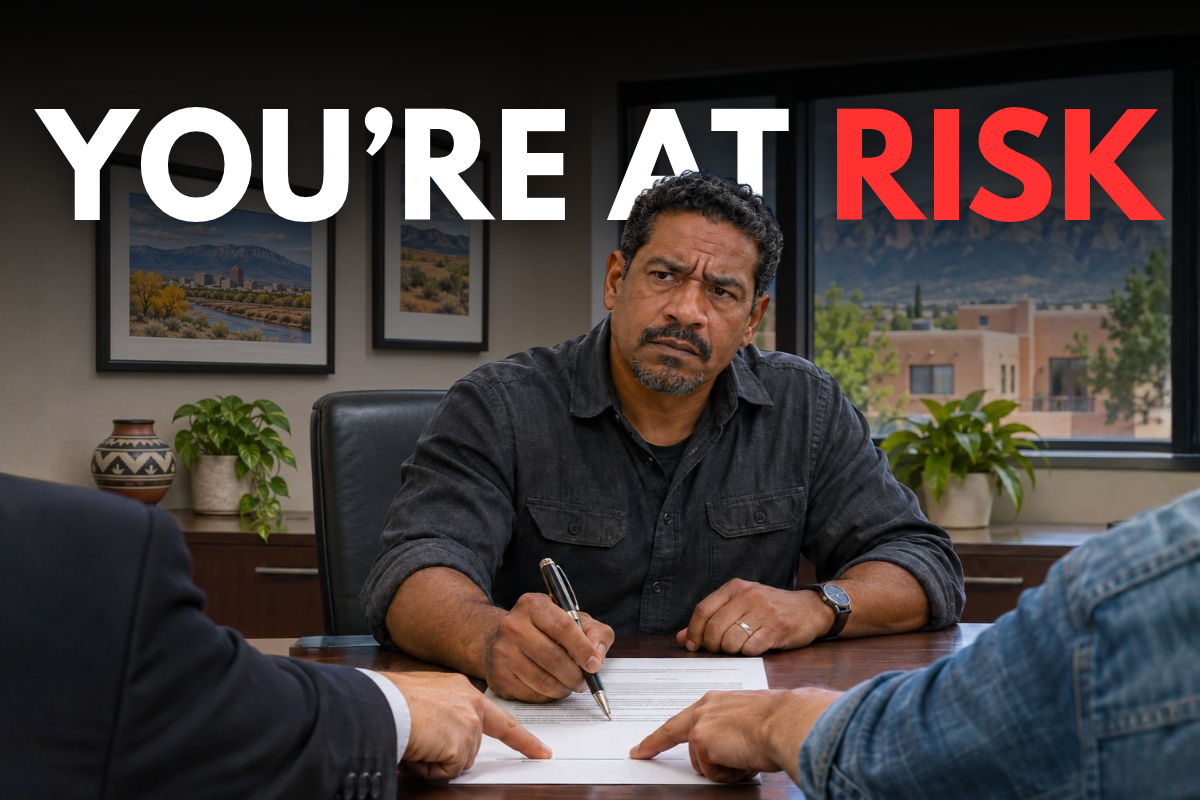
Wholesale Real Estate in New Mexico: What the Gurus Leave Out and How to Start With Little Cash
By Joshua Christensen, New Mexico Qualifying Broker and host of Door Life TV
A $15,000 wholesale fee looks pretty good on a seminar slide. Now picture this. It’s Friday afternoon, your investor just backed out, and the seller still expects you to close on Monday. Your name is on the $180,000 purchase agreement. Where’s the money coming from?
That’s the part I want the guy selling the course to walk me through before he sells me his contract.
I understand the appeal. You’re in your 40s or 50s, retirement is getting closer, and you’re looking for a way into real estate without draining the savings you spent years building. A low-cash entry can make sense. But in New Mexico, the difference between assigning your own contract and getting paid to sell somebody else’s house can carry serious consequences. And there are other ways to get started that give you a clearer role from day one. law.justia.com

What is wholesale real estate?
In a typical wholesale assignment, you sign a purchase agreement as the buyer. If the agreement allows the transfer and you obtain any required consent, you can assign your rights under that agreement to another buyer for a fee. The incoming buyer typically agrees to take on the buyer’s obligations. Whether the seller has released you from those obligations is a separate issue.
People in the industry often call the buyer’s position an equitable interest. Start with the practical question: What rights does your signed agreement actually give you? The seller still holds legal title before the sale closes. Read the agreement before you assume you can transfer your position, market anything, or walk away if your investor disappears.
Here’s how the numbers might work on a hypothetical Albuquerque house.
Item | Amount |
|---|---|
Purchase price under your agreement with the seller | $180,000 |
Earnest money due under the agreement, assumed credited at closing | $2,000 |
Fee the incoming investor agrees to pay for the assignment | $15,000 |
Investor’s acquisition cost before closing costs and repairs | $195,000 |
Estimated repairs | $35,000 |
Investor’s projected cost before financing, holding, and resale expenses | $230,000 |
The seminar puts the $15,000 in big type. I’d circle the $2,000 deposit and the $180,000 purchase obligation. If the investor disappears, your expected assignment fee goes to zero on that plan. What happens to your deposit, whether you can cancel, and what the seller can do depend on the agreement and the facts. Find out what you’re promising before you figure out what you might make.
Legal line #1: Getting paid to sell someone else’s property
New Mexico’s real estate license law addresses compensated brokerage activities performed for others. A single covered act or attempt can be enough. The statute also contains an exception for owners acting with respect to property they own. Before relying on that exception, have a New Mexico real estate attorney look at the interest you actually hold and what you intend to do with it. law.justia.com
Picture two people looking at that same Albuquerque house. One signed as the buyer and is offering to transfer a genuine, assignable position under that purchase agreement. The other runs a “House for sale. Send me offers” ad, takes buyers through the property, negotiates the owner’s sale, and expects a fee for bringing the parties together. In the second example, the conduct can look like brokerage even if the payment is labeled an assignment fee. The ad, the agreements, what you tell each party, and whose sale you’re negotiating all matter. law.justia.com
Under NMSA 1978, § 61-29-17(A), acting in the capacity of an associate or qualifying broker without the required license can constitute a fourth-degree felony. The New Mexico Real Estate Commission identifies possible penalties of 18 months’ imprisonment and a $5,000 fine. If you’re already licensed and buying for your own account, pay attention to the Commission’s rules on broker duties and written disclosure of potential conflicts. law.justia.com
Legal line #2: The “attorney-vetted” contract
There’s a difference between entering a purchase price on a form and writing a clause that changes who keeps the deposit, who can cancel, or who owes money after a failed closing.
In State Bar v. Guardian Abstract & Title Co., the New Mexico Supreme Court distinguished routine completion of certain attorney-prepared forms from work that affects substantial legal rights and requires legal judgment. The court also treated advising others about the legal effect of the documents at issue as practicing law. You can negotiate your own business terms as a party. Drafting legal protections for someone else or advising them what rights they’ll give up can raise unauthorized-practice concerns. New Mexico has a separate enforcement framework for those concerns. law.justia.com
Suppose your investor says, “Change the paragraph so I can cancel anytime, and tell the seller they’re still protected.” That’s when I’d put the pen down. If you’re considering an assignment, have a New Mexico real estate attorney review the purchase agreement, the assignment agreement, and the proposed ad together before you sign or advertise. The attorney needs to see how the whole deal is supposed to work.

How to start investing in real estate with little or no money
Here’s the deal, y’all. Your first move depends on what you actually have to work with. Steady income, a willingness to move, a marketable skill, and a small amount you can invest every month open different doors.
1. Buy a duplex you’ll actually live in
If you have steady income, can qualify for a mortgage, and are willing to move, this is the first direct-ownership option I’d investigate. Buy a duplex, live in one unit, and rent the other. You’ll learn how to buy, finance, and operate a property while the second unit helps cover your housing costs.
FHA financing can allow a minimum down payment of 3.5% for qualifying borrowers and properties. On a $300,000 duplex, assuming the full price is the basis for that calculation, that’s $10,500 before closing costs, prepaids, and any reserves. If you’re an eligible veteran, ask a VA lender about an owner-occupied duplex and whether you qualify for zero-down financing. Separately, ask a Housing New Mexico participating lender what assistance is available and whether the specific property type qualifies. Some assistance comes as a second mortgage, so ask when and how it’s repaid. hud.gov
Run the numbers before you shop. Say the total monthly mortgage payment, including taxes and insurance, is $2,200 and the other unit rents for $1,250. If you set aside $250 a month for vacancy and repairs, the rental contribution in your budget is $1,000. That leaves $1,200 in monthly housing costs for you before any owner-paid utilities or other expenses. These are sample figures, so use actual rent comps and a lender’s payment estimate for the property you’re considering.
My test is simple. Could you cover the full payment during a vacancy and still pay for an urgent repair? If that would put groceries on a credit card, buy at a lower price or build reserves first.
2. Use a skill to earn income and build your first reserve
If you have no savings today, this is where I’d start. An investor with a rental may need help with turnover cleaning, lawn care, or taking dated progress photos after a contractor finishes. Offer a defined service you can deliver. Agree in writing on the work and what you’ll be paid. Keep the role focused on that service and send your earnings to a separate property reserve account.
If you want to learn the transaction side, look for paid work with a licensed brokerage or property management company in a role with clear duties. Have the firm confirm which tasks you can perform. New Mexico restricts certain activities by unlicensed assistants, so keep your hands off work that requires a license, including negotiating deals or preparing sales contracts for others. law.justia.com
Here’s a target you can measure. $400 a month for 12 months builds $4,800 if you can consistently set that amount aside. Then you have real money for inspections, earnest money, or reserves, plus a year of seeing what it takes to turn over and maintain a property.
3. Consider an operating partnership once you can show what you bring
If you’ve run renovations, managed budgets, or successfully operated rentals, a capital partner may value that experience. Your contribution could be overseeing the operations of a property you genuinely co-own. Put the responsibilities and economics on paper. Who funds the purchase? Who approves a $12,000 repair? Who covers a shortfall? Who signs the loan guarantee? How does either partner get out?
I’d put this path after you’ve demonstrated a skill and learned how to evaluate a deal. Before soliciting money or accepting checks, have an attorney review the structure. Bringing in passive investors can implicate securities laws, including registration or exemption requirements. Ask counsel to review compensation as well if you’d be paid for finding or negotiating property for someone else. Offering Pathways
4. Start small with a publicly traded REIT if you want exposure before ownership
If you can invest a modest amount consistently and have no plans to move or operate a rental, a publicly traded real estate investment trust is another entry point. You buy shares in a company that owns or finances real estate. Share prices can fall, and distributions can change. For somebody who wants exposure to real estate while saving toward a future purchase, it’s a path worth understanding. Keep money you’ll need soon for closing costs or reserves out of investments whose value may fall right when you need it. Investor.gov

Build one door you can afford to keep
My One Door Control System starts with three things you can get specific about: acquisition, capital, and operations. What are you buying? How will you fund it? How will you keep it running when rent stops or a major repair comes due?
If you’re in Albuquerque or Rio Rancho and can qualify and move, price out one owner-occupied duplex with a lender and run the numbers through a vacancy. If you have zero reserves, start with one paid service and a separate savings account. Both give you a next step you can take before putting your name on a six-figure purchase agreement.
I’d rather see you spend the next year learning how to buy and keep one good property than spend it chasing a fee you can only collect if somebody else shows up on Monday.
Joshua Christensen
Qualifying Broker | Christensen Properties | (505) 250-1944
Powered by Realty One of New Mexico | (505) 883-9400
Joshua Christensen is a New Mexico Qualifying Broker, NMREC 20522, with Christensen Properties, powered by Realty One of New Mexico. For advice on a specific contract, advertisement, or ownership structure, consult a New Mexico attorney.



